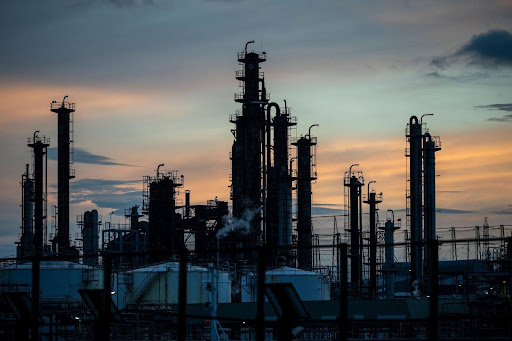
A combination of drone strikes on oil terminals and direct attacks on tankers is driving global oil markets into territory rarely seen in modern history, with Brent crude hovering near $100 a barrel Thursday as the Middle East conflict enters its third week. The breadth of Iran’s targeting — spanning Bahrain, Iraq, Oman, and the Strait of Hormuz — is systematically dismantling the infrastructure through which Gulf oil reaches the rest of the world. Markets are struggling to price in a scenario with few historical precedents.
Iran struck fuel tanks in Bahrain’s Muharraq Governorate, forcing shelter-in-place orders. Drone attacks targeted facilities near Oman’s Mina Al Fahal export terminal, prompting the evacuation of all vessels. Tanker attacks near Iraq led to the suspension of all crude exports from the country’s ports. The Thai-registered Mayuree Naree was struck near the Strait of Hormuz, with three crew members believed trapped.
Brent gained 9% Thursday to touch $100.29 before settling around $98. West Texas Intermediate rose 8.6% to $94.75. The price has climbed from $60 at the year’s start to a peak of $119 this week. The Strait of Hormuz — handling about a fifth of global seaborne energy — has been closed since February 28.
The IEA’s 400-million-barrel emergency release from 32 membernations and the US’s 172-million-barrel Strategic Petroleum Reserve contribution represented the most ambitious peacetime supply intervention in history. Iran’s military responded by warning of $200-per-barrel oil.
Goldman Sachs raised its Q4 2026 Brent forecast to $71 per barrel. Deutsche Bank flagged stagflation risks. Japan’s Nikkei fell 1.6%, South Korea’s Kospi declined 1.2%, and European gas prices rose 7.7%.