
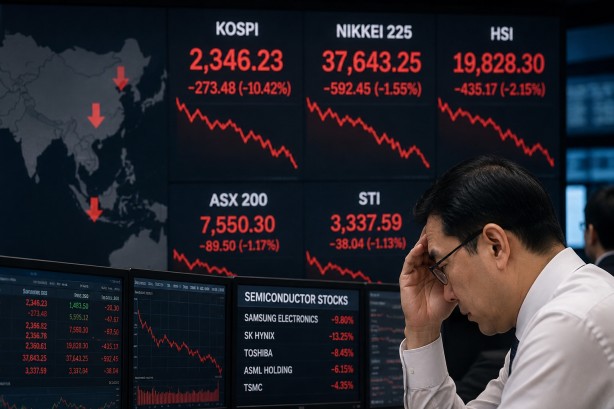
Asian stock markets experienced a downturn on Tuesday, with South Korea’s Kospi index suffering a significant blow, plummeting over 10%. The decline was primarily driven by substantial losses in the semiconductor sector, where key players Samsung Electronics and SK Hynix saw their shares drop by approximately 12%. The investor sentiment was dampened by increasing worries over the growing competition from Chinese artificial intelligence startups and chipmakers, which could potentially hinder the progress of the global AI industry.
While the South Korean market faced the steepest decline, other major Asian markets also ended the day on a negative note. Japan’s Nikkei, Taiwan’s Taiex, Hong Kong’s Hang Seng, and China’s Shanghai Composite all recorded losses, reflecting a broader regional trend of market uncertainty. In contrast, Australia’s S&P/ASX 200 stood out as the exception, managing to close with gains amid the overall regional market contraction.
The semiconductor industry’s struggles in South Korea are linked to fears that the rise of Chinese competitors could disrupt the current dynamics of the global AI sector. Investors are particularly concerned about the potential for these new entrants to capture market share, which could slow down the robust growth that has characterized the industry in recent years.
In the energy sector, oil prices saw a decline, influenced by the easing of tensions between the United States and Iran. This development has sparked optimism about the possibility of renewed diplomatic discussions, which in turn has alleviated some of the concerns regarding global energy supply disruptions. The easing geopolitical tension is seen as a positive sign for stabilizing oil markets, which have been volatile amid fears of potential supply constraints.